

Part 2 of 4 in our Controller to Cleats series.
Nobody ever lost their place in a team because of one game of EA FC. The cost of gaming rarely shows up in a single session. It builds up quietly, through later nights, shorter sleep, tired eyes and long hours on the sofa. Young players are usually the last to notice, because they feel fine until suddenly they don't. Here is what sports science says, and the limits we suggest around training and match days.
Sleep is where you get better
Training breaks your body down. Sleep is when it rebuilds. The American Academy of Sleep Medicine recommends 8 to 10 hours a night for teenagers aged 13 to 18, and at least 7 hours for adults. It also notes that young adults may need more.
The research on athletes points the same way:
Better performance with more sleep. In a well-known Stanford study, 11 college basketball players tried to sleep longer for five to seven weeks. Their sprint times got faster and their shooting improved. It was a small study, but the direction was clear.
Injury risk. A 2014 study of 112 adolescent athletes found that those who slept less than 8 hours a night had 1.7 times the injury risk of those who slept 8 hours or more. This shows a link, not proof of cause, but it is worth taking seriously.
Thinking speed. A 2015 review of sleep and athletic performance found that some all-out physical efforts can hold up after poor sleep. But sport-specific performance tends to drop, and many studies found slower and less accurate thinking. Football runs on decisions, so that matters.
How gaming eats into sleep
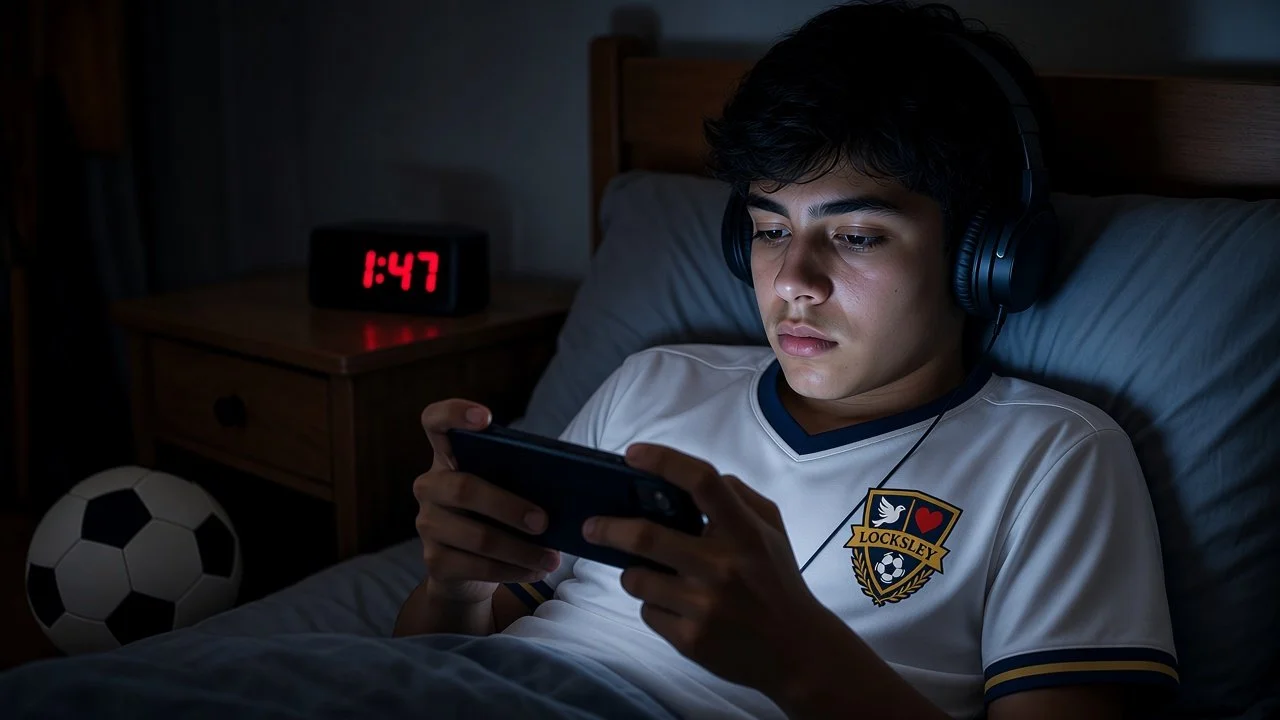
Games are designed to keep you playing. "One more match" is how midnight turns into 2am.
In a 2014 sleep-lab study, 21 players aged 15 to 20 gamed before bed. The longer they played, the less they slept, and the worse their attention was the next day. The researchers found that the lost sleep explained the whole drop in attention.
A 2024 study in JAMA Pediatrics filmed 79 young people aged 11 to 14 at home before bed. Screen use in the two hours before bed was not linked to most sleep measures. But gaming once they were in bed was: every extra 10 minutes of gaming in bed was linked to about 17 fewer minutes of sleep. Interactive screens like games also pushed back the time they fell asleep.
The lesson is simple. The real danger is gaming late and gaming in bed.
Your eyes, neck and shoulders
The American Optometric Association lists eyestrain, headaches, blurred vision, dry eyes, and neck and shoulder pain as the most common symptoms of digital eye strain. Poor lighting, glare, sitting too close and bad posture make them worse. The AOA recommends the 20-20-20 rule: every 20 minutes, look at something about 20 feet (6 metres) away for 20 seconds.
Hours on the sofa
The World Health Organization recommends that young people aged 5 to 17 get an average of at least 60 minutes of moderate to vigorous activity a day. It also says they should limit sitting time, especially recreational screen time. The WHO doesn't set a fixed number of hours, because the evidence wasn't strong enough. Training covers a lot of your activity on most days, but long gaming marathons on rest days mean a lot of hours sitting still.
When it stops being fun
The World Health Organization recognises "gaming disorder". It means losing control over your gaming, putting games ahead of other parts of your life, and carrying on even when it causes harm. Usually this has to go on for at least 12 months before it is diagnosed. It affects only a small minority of gamers, but football is not immune. In 2019 England's players' union, the PFA, said some clubs had asked it to talk to their players about gaming addiction. More on that in the next post.
Practical limits around training and match days
These are our suggestions, built on the research above:
The night before a match: finish gaming at least an hour before you plan to sleep, and never take the controller or phone into bed.
Match day: no gaming before kick-off. Remember the study from Post 1, where an hour on a football game before a match slowed players' decisions.
After a late match: you'll feel wired. A short, calm session is fine, but set an end time before you start.
Training days: train, refuel and stretch first. Game later.
Rest days: get outside. Walk, kick a ball with friends, see daylight.
Every session: follow the 20-20-20 rule and stand up between matches.
If you would like more information on our representation services please feel free to reach out.
Sources
Paruthi et al. (2016), Recommended Amount of Sleep for Pediatric Populations, AASM consensus (PMC)
AASM, Seven or more hours of sleep per night: a health necessity for adults
Fullagar et al. (2015), Sleep and athletic performance, Sports Medicine (PubMed)
WHO Guidelines on Physical Activity and Sedentary Behaviour, Recommendations (NCBI Bookshelf)
