

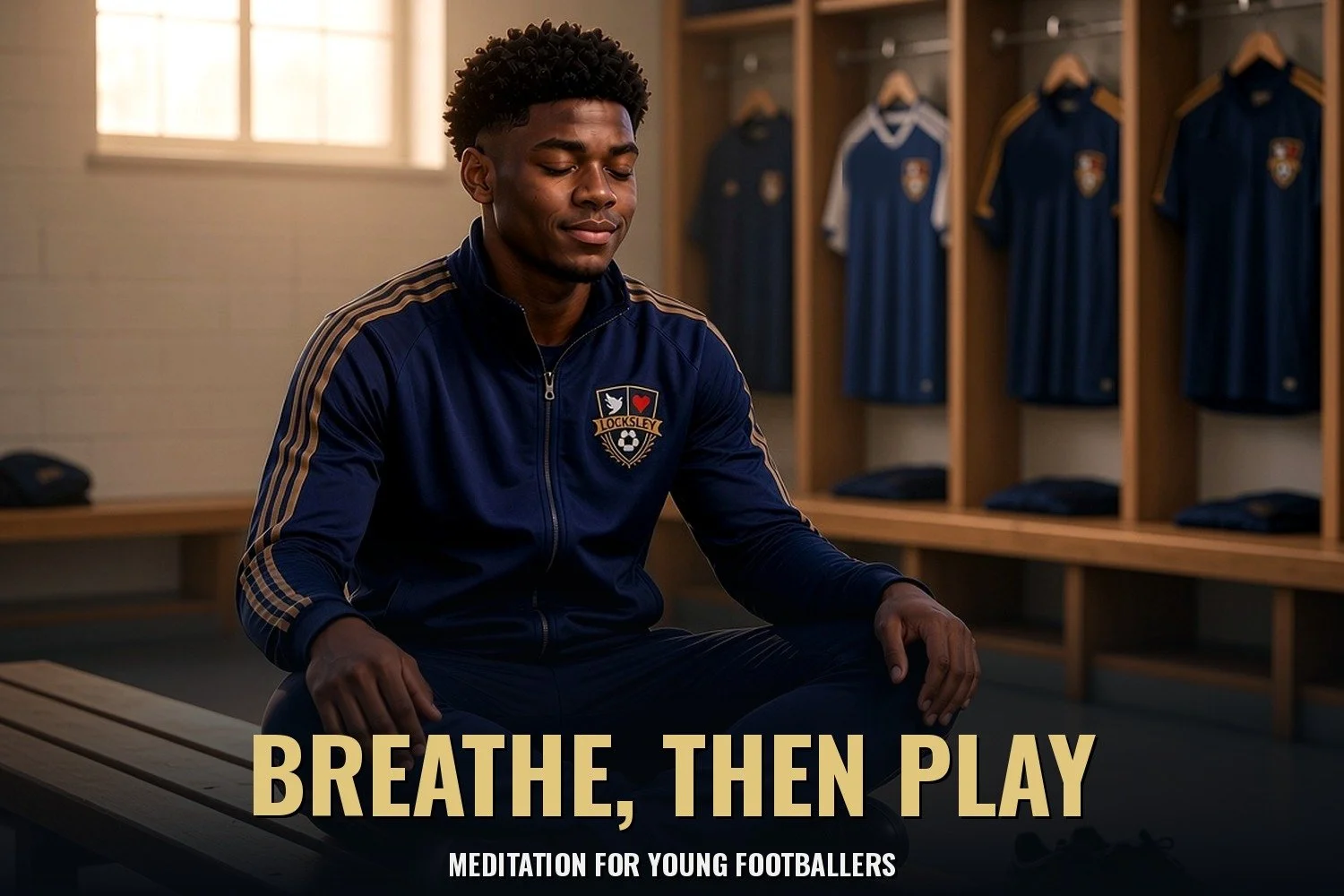
A young footballer can be fit, technically sharp, and still have a poor session if their head is already on the last miss, the scout on the touchline, or the match still an hour away. Meditation is not a mystic shortcut, and it will not replace training, sleep, or food. It is a simple way to practise being present. A growing number of professionals treat it as part of their preparation, the same as a warm-up.
What it is, and what it is not
Meditation, in the form most often studied in sport, is usually a mindfulness practice: you sit still, pay attention to the breath or the body, and notice thoughts without chasing them. The aim is not to empty the mind. The aim is to notice what is happening now, and to come back when the mind wanders, which it will. It is not a treatment on its own. If a player has persistent anxiety, low mood, or sleep problems, or if sitting quietly makes things worse, that is a reason to speak to a parent, a doctor, or a qualified psychologist, not to "meditate harder."
What the research actually says
The evidence is promising, and it is not magic. A 2017 meta-analysis in Sports Medicine, covering nine trials and 290 athletes aged over 15, found that mindfulness practice improved mindfulness scores and psychological performance measures, and that performance itself improved in shooting and dart throwing. The authors said it is reasonable to treat mindfulness as a complementary mental-skills approach, at least in precision sports, but that more high-quality trials are needed. Football was not the main setting, and nobody should read that review as a guarantee of more goals.
A 2023 review in the British Journal of Sports Medicine looked at 12 randomised trials in 614 elite athletes. Mindfulness-based programmes reduced symptoms of anxiety and stress and increased psychological well-being, with moderate certainty of evidence and results that varied from study to study. A 2019 review of 18 trials, in 1,654 people, found that mindfulness meditation improved sleep quality compared with nonspecific control programmes, but not compared with established sleep treatments. After injury, a 2024 systematic review found associations with better psychological adaptation — lower anxiety and depression, higher pain tolerance and well-being — but little effect on physical healing, and the evidence is still limited. It may help a player cope during rehab. It will not knit a ligament back together.
Much of this research is in older adolescents and adults. A short daily habit is a reasonable way to start, not a clinical programme.
What the pros actually say
Raheem Sterling began using it in his downtime at Euro 2020. "I try and do it before I go to sleep — get relaxed before I go to sleep. Just taking time out, being thankful and grateful for the day," he told reporters.
Cristiano Ronaldo, speaking to France Football in 2019, said he had tried meditation for 15 to 20 minutes and that "it really works." "It calms and brings me a lot of serenity. I meditate almost every day, working especially on breathing. In those moments, I'm in my bubble."
Mohamed Salah has described a similar habit. In a 2022 interview with France Football, he said meditation helps him keep his attention on one thing at a time, and that it relaxes him under the stress of chasing trophies. He tries to meditate every day, for 10 or 20 minutes, at home, alone.
Erling Haaland has said he enjoys meditation because it makes him feel calm and gives him tranquillity, which is why he sometimes uses his "Zen" celebration after a goal.
Anthony Gordon, speaking to Gary Neville on The Overlap, uses meditation and visualisation in the two days before a match, so that if a chance comes he feels he has "already lived it" and can "be present and trust my ability rather than overthink it." He does it sitting in a quiet room, eyes closed, "getting in touch with your body through breathing" — not necessarily cross-legged.
Carli Lloyd, after the 2015 Women's World Cup, told People: "For me there is no shame in saying that I visualize and I meditate because it really works. I was doing it all throughout the World Cup." Her teammate Kelley O'Hara later told The Guardian she meditates before every game, something she added as she got older, when she realised she needed "certain things you can fall back on."
The lesson is not to copy a professional's exact routine. It is that the mind can be trained, like the body, and that a short, regular practice is the point.
A five-minute routine
The programmes in the research were often weeks long. Five minutes will not reproduce those results on its own. It is a way to start, before training, before a match, or before sleep. A chair is enough. You do not have to sit cross-legged. Put the phone away.
Minute 1. Sit upright, feet on the floor if you are on a chair. Notice the contact with the seat or the ground. Take one slower breath in through the nose, and a slightly longer breath out.
Minutes 2 to 4. Breathe in for a count of four, and out for a count of six. When the mind wanders — to the session, the opposition, or something from school — notice it and come back to the count. That return is the practice, not a failure.
Minute 5. Drop the count. Take two ordinary breaths. Open the eyes, notice how you feel, and then get up and go.
Before a match, some players, like Gordon, add a simple run-through in the mind: arriving, warming up, and how they want to play. Start with the breath first. Before sleep, keep it quieter still, closer to Sterling's version: a few minutes to settle, not a replay of every touch from the session.
For parents
This is a skill to try, not a test to pass, and not a replacement for professional help. Start short. It should not be piled onto an already full week as extra homework.
Watch for the difference between ordinary pre-match nerves and something that is getting in the way of sleep, school, or enjoying the game. If a child is unusually withdrawn, anxious, or low for more than a short stretch, or if sitting with their thoughts leaves them more distressed, stop and speak to a doctor or a qualified psychologist. Meditation can sit alongside training and recovery. It does not replace sleep, meals, or medical care.
Sources
- Bühlmayer, L., Birrer, D., Röthlin, P., Faude, O., and Donath, L., Effects of Mindfulness Practice on Performance-Relevant Parameters and Performance Outcomes in Sports: A Meta-Analytical Review, Sports Medicine (2017): pubmed.ncbi.nlm.nih.gov
- Myall, K., Montero-Marin, J., Gorczynski, P., Kajee, N., Syed Sheriff, R., Bernard, R., Harriss, E., and Kuyken, W., Effect of mindfulness-based programmes on elite athlete mental health: a systematic review and meta-analysis, British Journal of Sports Medicine (2023): pubmed.ncbi.nlm.nih.gov and bjsm.bmj.com
- Rusch, H. L., Rosario, M., Levison, L. M., Olivera, A., Livingston, W. S., Wu, T., and Gill, J. M., The effect of mindfulness meditation on sleep quality: a systematic review and meta-analysis of randomized controlled trials, Annals of the New York Academy of Sciences (2019): pubmed.ncbi.nlm.nih.gov
- Liu, S., and Noh, Y.-E., The effectiveness and applicability of mindfulness intervention in psychological adaptation after sports injury: a systematic review, Australian Journal of Psychology (2024): pmc.ncbi.nlm.nih.gov and doi.org
- Raheem Sterling, remarks to British media, reported by Reuters / Sportstar (16 June 2021): sportstar.thehindu.com
- Cristiano Ronaldo, interview with France Football, reported by The Independent (29 October 2019): independent.co.uk
- Mohamed Salah, interview with France Football (June 2022), as reported by il Napolista (11 June 2022) and Football365: ilnapolista.it and football365.fr
- Erling Haaland, interview with Esporte Interativo, reported by ESPN (6 March 2020): espn.co.uk
- Anthony Gordon, interview with Gary Neville on The Overlap, reported by talkSPORT (23 April 2024): talksport.com
- Carli Lloyd, interview with People (9 July 2015): people.com
- Kelley O'Hara, interview with The Guardian (6 July 2019): theguardian.com
