

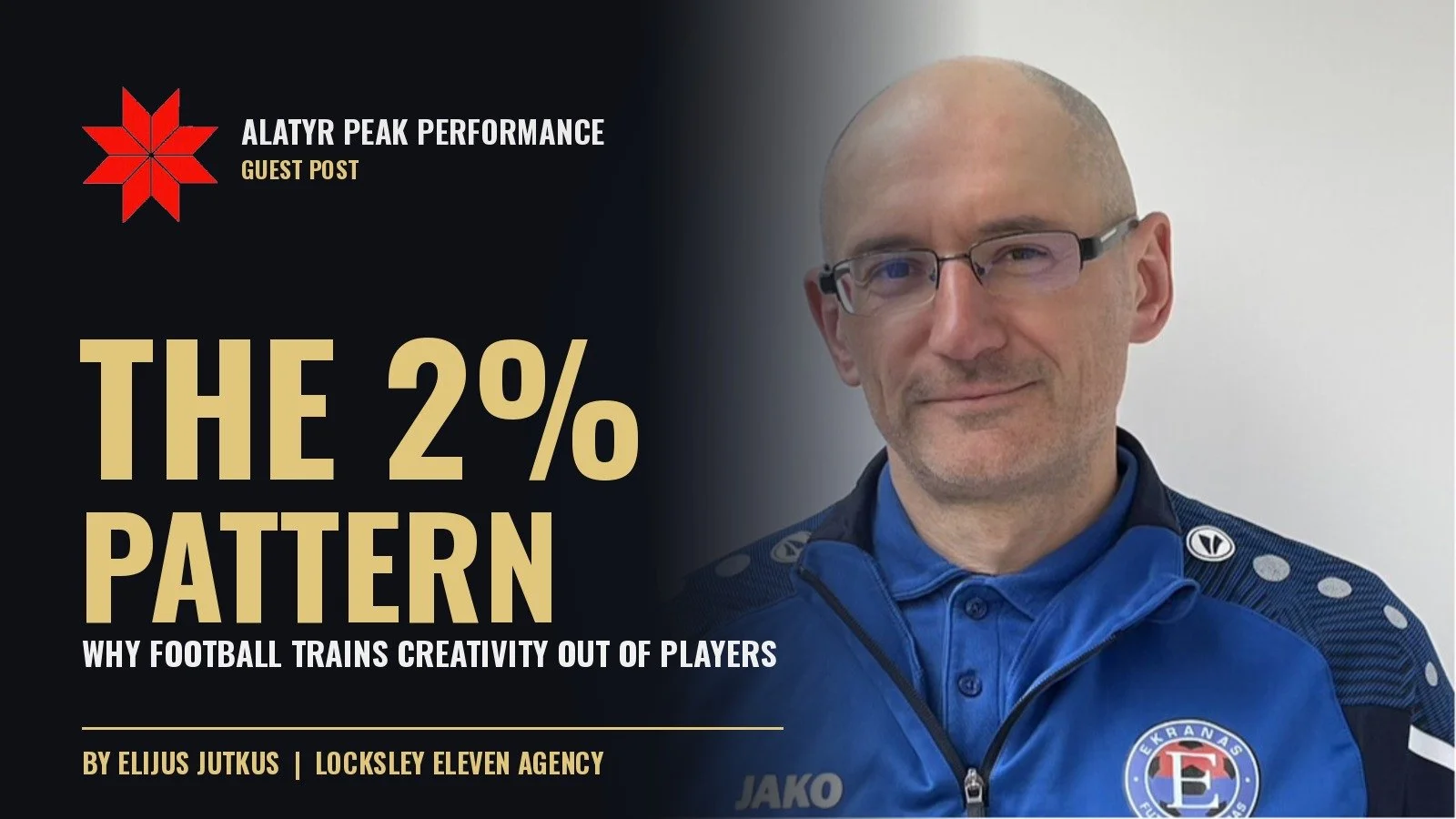
By Elijus Jutkus, Alatyr Peak Performance
What do a 1960s NASA creativity test and football have in common? The same number: 2%.
In the late 1960s, NASA wanted to find the most creative minds before they were hired. Dr George Land built a creativity test for NASA recruits, then gave it to 1,600 children about 5 years old.
98% scored at creative-genius level.
He retested the same kids at 10: 30%. At 15: 12%. Adults: 2%.
Nobody simply 'loses their talent'. It is taken away.
Now look at football.
Under EPPP rules, academy registration starts at Under-9. At that age, by Land's numbers, around 30% of kids still think like geniuses. They are picked up exactly when the clock is already ticking.
So where do those kids end up?
Sky Sports' Chasing the Dream found that 91% of academy players never play a competitive professional game. A University of Essex study of teenage players at Madrid academies found fewer than 4% (7 of 198) reached top-tier football. And estimates put those who forge a full professional career at just 1-2%.
2% again.
Coincidence? Maybe. Yet the numbers rhyme, and this rhyme cannot be unseen.
Here's the open secret: creative thinking is a skill. Education that rewards recall over original thinking tends to train it out of us.
The good news: what can be trained out can also be trained back in.
The people at the very top of every field seem to know it. The rest of us are told to memorise, then graded on how many random facts we remember. And the gap between those at the top and everyone else only grows.
So is creative thinking the tool that narrows it?
I've seen it first-hand. Of all the players I've worked with, two truly bought in:
Adam Laaref went from bit-part player to star of the team, then scored the promotion-clinching goal in East Fife's play-off final.
Mo Dabre, one of the brightest players in the National League South, had been coached out of his creativity and told to just "run until you drop". He rediscovered the magic, and now he creates chance after chance for his teammates.
Two players out of over a hundred I've worked with. Roughly 2%.
Now imagine the whole squad playing like that.
That's the picture I'm working towards, and it takes someone with creative vision to say yes.
The search continues for the 2% of chairmen who envision it too. If you know one, share this with them.
About the author
Elijus Jutkus is a London-based performance coach and the founder of Alatyr Peak Performance, which helps footballers train creative thinking and mindfulness alongside their physical game. He has worked with more than a hundred players, including East Fife's Adam Laaref and National League South's Mo Dabre. He is releasing an app where he has put the knowledge from his experience working in football with players from grassroots to Premier League academies. The app launches in mid-December 2026. LinkedIn
Sources
- George Land, TEDxTucson, "The Failure Of Success": https://www.youtube.com/watch?v=ZfKMq-rYtnc
- Premier League, Elite Player Performance Plan (EPPP): https://www.premierleague.com/en/footballandcommunity/youth-development/eppp
- Sky Sports, "Chasing the Dream" (91% of academy players never play a professional match): https://www.skysports.com/football/story-telling/13257286/chasing-the-dream-trent-alexander-arnold-and-kyle-walker-discuss-the-embarrassing-problem-in-academy-football
- University of Essex / EurekAlert, "Only 4% of teen football academy prospects make top tier": https://www.eurekalert.org/news-releases/1049538
- Sky Sports, "Chasing the Dream" (1.5% of academy graduates play one Premier League match): https://www.skysports.com/football/news/13256523/chasing-the-dream-pep-guardiola-sir-alex-ferguson-and-many-more-discuss-the-impossible-journey-to-professional-football
